Feeds:
Posts
Comments

NATO Chicago, posted with vodpod

Remarks at the North Atlantic Council Meeting

Remarks

Hillary Rodham Clinton
Secretary of State
Chicago, IL
May 21, 2012

Thank you very much, Deputy Secretary General Vershbow, for chairing today’s meeting of the North Atlantic Council. I am delighted to be joined by my fellow foreign ministers from the NATO member-states and from the nations of Georgia, Macedonia, Montenegro, and Bosnia-Herzegovina. And let me again welcome you to Chicago, which happens also to be my birthplace and one of America’s great cities.We’re meeting today to reaffirm our commitment to NATO’s open door policy. The possibility of NATO membership has proven to be a powerful motivation for countries to implement difficult but necessary reforms, resolve internal differences as well as differences with their neighbors, and contribute to security operations that benefit themselves and all of us. Our open door policy has produced some of our most active and committed allies, and it has helped produce stability and cooperation in Central and Eastern Europe. And more broadly as NATO has grown, Europe has become more secure and more prosperous.

So the United States remains deeply committed to the open door policy, and it is in that spirit that we welcome our aspirant nations here today. We support their aspirations for Euro-Atlantic integration, and we will keep working with each of them, both bilaterally and through NATO, to help them implement finally the reforms needed to meet the standards for membership. As I said yesterday, I believe this summit should be the last summit that is not an enlargement summit.

To speak just briefly about each aspirant, Georgia will become the largest non-NATO contributor to the ISAF mission in Afghanistan this fall, and we are very grateful for its contributions. Georgia has made democratic reforms, and the upcoming parliamentary and presidential elections are additional opportunities for Georgia to show the world that it is committed to NATO’s democratic values. We stand firm in our support for Georgia’s sovereignty and territorial integrity. We welcome Georgia’s non-use of force pledge, and we call on Russia to reciprocate with its own pledge. We stand by the Bucharest decision and all subsequent decisions on Georgia.

Macedonia has also made contributions to regional and global security, including significant and longstanding contributions to ISAF, and it has fulfilled the key criteria for NATO membership. We strongly support a resolution of the ongoing name dispute and urge the parties to reach an agreement so Macedonia can join the alliance as soon as possible.

Montenegro, too, has made contributions to ISAF and reforms in its military and security services, which we applaud. The U.S. plans to send an advisor from the Department of Defense, and we welcome similar initiatives by other allies to support Montenegro’s efforts to implement the remaining reforms for NATO membership. Support for NATO membership is growing among the Montenegrin people, and we encourage efforts to continue increasing public awareness and understanding.

Finally, regarding Bosnia and Herzegovina, we welcome the political agreement on defense properties and now we urge that it be implemented. And we encourage Bosnia, Macedonia, and Montenegro to continue pursuing regional initiatives like the Balkan Regional Approach to Air Defense, as well as natural disaster preparedness and the joint ISAF deployment by the Adriatic-5 Group.

Regarding all these countries, as with any country that wishes to join NATO, we look to them to demonstrate that they share our values and they are willing and able to meet the standards for membership. And we promise to help them as they do so because this is in our interest. We know it can be a lengthy and challenging process, but we need to stick with it and remember our ultimate goal: a stronger, more durable, more effective NATO.

In 1949, we were 12 nations; now we’re 28. The result is an alliance that has proven over and over it can meet the threats and overcome the challenges of our time. And here in Chicago, let us reaffirm our commitment to enlargement done right as a core element of our purpose and our community. Thank you very much.

Video Address to 1,000 Days Event in Chicago

Press Statement

Hillary Rodham Clinton
Secretary of State
Washington, DC
May 21, 2012

Greetings from Washington. I’d like to thank Mayor Emanuel, the City of Chicago, World Business Chicago and all the civil society partners that have joined together for this truly exceptional summit – “1,000 Days to Change the Future: Making Malnutrition History.” As hosts of this year’s G8 and NATO summits, the U.S. is proud to work with our partners to drive progress toward a more peaceful and prosperous world. We believe that food and nutrition security for all are an integral part of the foundation upon which democracy, economic growth and stability rest.Science has taught us how we can take action to build a stronger foundation and break the cycle of hunger and poverty. We know that malnutrition in the 1,000 day window between pregnancy and a child’s second birthday leaves children increasingly vulnerable to disease, impairs their cognitive and physical development, and lessens their lifetime earning potential. By improving nutrition during this critical 1,000 day window, we can prevent almost 3 million child deaths per year.

And as leading economists will tell you, improving nutrition for mothers and children is one of the most cost-effective and impactful tools we have for poverty alleviation and sustainable development.

That is why I launched the 1,000 Days Partnership in 2010 to support SUN – the Scaling Up Nutrition movement – and draw attention to the 1,000-day window of opportunity. 27 leaders have signed up to SUN in their countries and are already making significant progress.

At today’s summit, we have an opportunity to help accelerate global action on malnutrition. Governments, businesses, universities, civil society organizations, and foundations must invest now to bring proven models and programs to scale, or we risk diminishing the impact of our other investments in education, health, food security, and economic growth.

If we act together, we can start making malnutrition a thing of the past…we can safeguard the futures of millions of children and finally make malnutrition history. Thank you for all that you are doing, and I look forward to hearing all about your work at today’s important event.

This slideshow requires JavaScript.

Public Schedule for May 21, 2012

Public Schedule

Washington, DC
May 21, 2012

U.S. DEPARTMENT OF STATE
PUBLIC SCHEDULE
MONDAY MAY 21, 2012

SECRETARY HILLARY RODHAM CLINTON

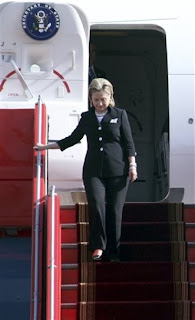
Secretary Clinton is on travel to Chicago, Illinois for the NATO Summit. Secretary Clinton is accompanied by Assistant Secretary Gordon, U.S. Ambassador to Afghanistan Ryan Crocker, U.S. Ambassador to NATO Ivo Daalder, U.S. Ambassador to Pakistan Cameron Munter, Special Representative Marc Grossman, Chief of Protocol Marshall, Director Sullivan, and VADM Harry B. Harris, Jr., JCS.

AM – PM Secretary Clinton joins President Obama for events surrounding the NATO Summit, in Chicago, Illinois.

11:00 a.m. Secretary Clinton participates in the NATO Foreign Ministers meeting with aspirant countries, in Chicago, Illinois.
(OPEN PRESS COVERAGE FOR OPENING REMARKS)

12:05 p.m.Secretary Clinton holds a bilateral meeting with Japanese Foreign Minister Koichiro Gemba, in Chicago, Illinois.
(POOLED CAMERA SPRAY PRECEDING BILATERAL MEETING)

For some mysterious reason, the State Department just published this.  Better late than never, I suppose.

This slideshow requires JavaScript.

Public Schedule for May 20, 2012

Public Schedule

Washington, DC
May 20, 2012

U.S. DEPARTMENT OF STATE
PUBLIC SCHEDULE
SUNDAY MAY 20, 2012

SECRETARY HILLARY RODHAM CLINTON

Secretary Clinton is on travel to Chicago, Illinois for the NATO Summit. Secretary Clinton is accompanied by Assistant Secretary Gordon, U.S. Ambassador to Afghanistan Ryan Crocker, U.S. Ambassador to NATO Ivo Daalder, U.S. Ambassador to Pakistan Cameron Munter, Special Representative Marc Grossman, Chief of Protocol Marshall, Director Sullivan, and VADM Harry B. Harris, Jr., JCS.

AM – PM Secretary Clinton joins President Obama for events surrounding the NATO Summit, in Chicago, Illinois.

11:55 a.m. Secretary Clinton participates in the US-NATO-EU trilateral meeting with European Union High Representative Catherine Ashton and NATO Secretary General Anders Fogh Rasmussen, in Chicago, Illinois.
(CAMERA SPRAY PRECEDING MEETING)

1:10 p.m. Secretary Clinton meets with Pakistani President Asif Ali Zardari, in Chicago, Illinois.
(CAMERA SPRAY PRECEDING MEETING)

6:30 p.m. Secretary Clinton attends the NATO Foreign Ministers working dinner, in Chicago, Illinois.
(CLOSED PRESS COVERAGE)

There is no text to accompany these photos, but we all have been eager to see the new French officials with whom our girl will be interacting in the months to come.  We see her here at Blair House with French President Francois Hollande, her new counterpart, French Foreign Affairs Minister Laurent Fabius,  and French Economy, Finance and Foreign Trade Minister Pierre Moscovici.

This slideshow requires JavaScript.

Chicago Council Event, posted with vodpod


Remarks on Global Food Security

Remarks

Hillary Rodham Clinton
Secretary of State
Ronald Reagan Center
Washington, DC
May 18, 2012

Oh, thank you all. Thank you. Thank you. Well, that was really a wonderful introduction from someone who I’ve had the great pleasure of working with on a number of important issues and am delighted to be working so closely with Senator Lindsey Graham again, as he is the ranking member on the Foreign Operations Subcommittee of the Senate Appropriations Committee. And I’m so appreciative of his strong support of America’s development and diplomatic efforts around the world. We promised him that we would seize and erase all tapes of what he has just said. (Laughter.) So don’t take it personally, any of you in the press, but this is to protect him going forward. (Laughter.)

Well, this has been an amazing day, and I’m all that stands between you and getting out into this absolutely beautiful afternoon and enjoying some of the sights that Washington has to offer. But I wanted to come to close out the formal part of the program to express great appreciation, first and foremost, to the Chicago Council – in particular, Catherine Bertini and Dan Glickman for bringing us all together today to our very special guests, the heads of state and government from Tanzania, Benin, Ethiopia and Ghana, and to tell you how exciting it is that we have this partnership at the highest levels with the countries that you represent here at this conference and for the months and years ahead. I also want to thank Raj Shah and his great colleagues at USAID. Raj has led a tireless effort on behalf of advancing food security worldwide along with the wonderful help of people not only here in Washington but in our posts and missions across the globe.

Thanks to our G-8 partners. I see representatives from the G-8 countries here. Thank you for your commitment to food security, for the great work that started in L’Aquila and has continued forward to here in Washington. And thanks to all of you in the private sector, in the not-for-profit sector, in the academic world, in the faith community, in the agricultural productivity and research world. Thank you all.

And this has been a real diverse conference. Not only heads of state and government and foreign ministers and aid workers and health experts and businessmen and women, but we had at least one rock star. I have it on very good authority. (Laughter.) And although we hail from different regions and hold different points of view, as Senator Graham said about his and my perspectives, on this we all agree – the need to drastically decrease hunger and poverty worldwide. And strengthening global agriculture is a powerful way to do that.

Now it wasn’t long ago that a symposium on food security would have drawn a very different crowd, because for years, passionate and persistent advocates made the case that this issue needed to be on the development agenda of every nation. Well, the United States listened, the G-8 countries listened, and now it’s a signature issue. Billions of dollars have been pledged by the world’s largest economies, and those pledges are being met. The G-20 has embraced this mission. So has the World Bank and the African Union. And 30 African nations are creating national agricultural investment plans and revising their budgets to make agriculture a leading priority.

Now in the United States, we’ve created our own global food security initiative, and as you were able to hear directly from President Obama earlier today, Feed the Future is at the forefront of our global development agenda. Now we took on food security right out of the box in this Administration because the facts were so compelling. Yes, it’s a complex, far-reaching issue, but it comes down to a couple of very key facts – nearly a billion people worldwide suffering from chronic hunger; by the year 2050, the global population will climb to 9 billion, and the world will need to produce 70 percent more food than we do today just to feed everyone; 75 percent of the world’s poor live in rural settings and depend on agriculture for their livelihoods.

Now there are many other facts, but I think these three are sufficient not only to make the case, but to add up to a tremendous opportunity, because if we can help the rural poor produce more food and sell it in thriving local and regional markets as well as on the global market, we can decrease chronic hunger today, we can build an ample food supply for tomorrow, we can drive economic growth in places where poverty is persistent, and we can have better futures for men, women, and children.

Now I think what we are seeking to do through our investments in global agriculture is not just to solve the problem of hunger, we also want to solve the problem of extreme poverty. And agriculture, in our opinion, may be the best intervention point to do that. Development dollars spent on agriculture have the greatest impact on poverty reduction, more than money spent in any other sector. So if we want to make big gains in the fight against poverty, agriculture is the best way to do that.

And there is no place that that is more true than in Africa, where there is such great potential for gains in agricultural productivity. So together, African governments, donors, international organizations, the private sector, and civil society can close the productivity gap and feed many more people.

Now having said that agriculture development can deliver strong results, I have to admit the goals we have set for ourselves are very ambitious. They need to be. The countries that we are supporting are trying to transform how people farm, what people eat, how crops are stored and sold, and that is not easy. Some of the changes they seek will take years, perhaps even generations, to lock into place. So we need to have the foresight and to stay committed to this mission.

Many worthy ideas have been shared here today about what should come next in the global fight for food security. And I want to emphasize three issues that I believe deserve our particular attention. All three are areas in which progress is both urgently needed and well within our reach. And all are priorities of the New Alliance for Food Security and Nutrition that President Obama announced this morning.

The first is a centerpiece of this symposium: partnering with the private sector. As President Obama said earlier, the New Alliance includes a major push to mobilize more private sector investment and involvement. Now part of the reason for that is simple math. Consider the 30 African countries that have created or are now creating comprehensive national agriculture investment plans. When we look at their own spending, even in those countries that have met the goal of allocating 10 percent of their national budget to agriculture, and then when we add to that the pledged support from development partners like the members of the G-8, a significant gap still remains because governments alone cannot supply all the investment needed to transform agriculture. We need the private sector.

Now that’s not only true only of agriculture. Private investment has become invaluable to development across the board. In the 1960s, official development assistance from governments and multilateral organizations accounted for 70 percent of capital flows going into developing countries. But today that number has fallen to just 13 percent. And that’s not because public assistance has gone down; it’s because private investment has skyrocketed. Now we need to drive more of that investment toward agricultural growth.

And beyond investment, the private sector has a great deal to offer in terms of skills and expertise. Whether it’s improving the supply chain so fewer crops are spoiled on their way to market, as Premium Foods is doing in Ghana; or training growers in certified seed production, like Tanseed is doing in Tanzania; or expanding the production and processing of highly nutritional foods like chickpeas and soybeans, as Guts Agro Industry is in Ethiopia, businesses often know how to do important things better and more cost effectively than anyone else.

African countries are taking the lead on cultivating private sector involvement. They are reforming their policies to make their economies and agricultural sectors more attractive for both domestic and international investment and private sector activity. Their partners can support this by launching our own innovative collaborations with businesses, both local and international.

Now, I do realize that not everyone welcomes wholeheartedly the notion of more private sector involvement. And let me be clear that while global corporations play an irreplaceable role, we want them to prosper alongside local business, not at their expense. Private sector activity must start with the smallholder farmers whose future prosperity is the focal point of all our efforts, and then expand outward from there.

Furthermore, I know that some worry that by asking the private sector to step up, governments are hoping that gives us the excuse to scale back. Well, I want to say as clearly as I can that the United States is in this for the long run. And we ask others to hold us accountable as we will do the same in turn. And we believe accountability must apply to our private sector partners as well. But private sector activity is the only lasting basis for self-sustaining economic growth. And ultimately, after all, isn’t that our goal?

The second topic I want to emphasize is nutrition. In recent years, we have learned that improving access to food does not automatically lead to improved nutrition. Neither does raising incomes nor creating new markets. What leads to improved nutrition is focusing on nutrition itself and integrating it into all our food security initiatives.

Nutrition is just too important to be treated as an afterthought. Children’s entire lives are shaped by whether they receive enough of the right nutrients during those crucial 1,000 days from pregnancy to second birthdays. And this, in turn, heavily influences whether a country will have a healthy and educated workforce. So when we overlook nutrition, we set ourselves up for a less healthy, less productive, less prosperous future.

Two years ago, during the annual meeting of the UN General Assembly, I joined international leaders, including Secretary General Ban Ki Moon, the foreign minister of Ireland and others, in announcing the “1,000 Days” partnership in support of the Scaling Up Nutrition movement known as SUN. That was the first time foreign ministers had gathered to focus squarely on nutrition as a critical development priority. And since then, a growing number of countries have committed to improving nutrition. Twenty-seven countries have committed to taking action through the SUN movement, and I urge more countries to join because we have proven solutions to the problem of under- and mal-nutrition

And let me also say that under-nutrition is not just a problem facing only developing countries. We’re struggling with it in the United States, and we have plenty of food. But many people, including far too many children, are not eating nutritious foods. They’re eating, but they’re not eating in a way that improves and sustains their health, and they are increasingly facing serious health problems.

In Chicago on Monday, while the NATO summit is underway, there will be a “1,000 Days Summit” to focus on the problem of child under-nutrition, not only abroad but here at home in cities like Chicago. Mayor Rahm Emanuel is taking on the so-called “food deserts” as a public health priority, because this problem of under-nutrition cuts across all borders and all incomes.

The United States has a set an ambitious nutrition target within Feed the Future. We aim to reach 7 million children within five years to prevent stunting and to increase child survival. I think we have the capacity to reach even more, and if we all work together we can set a global target.

The third issue I want to emphasize is gender equality. I’m sure it’s no surprise to anyone that I am convinced women are critical to our success in every field of endeavor. And this is not a matter of sentiment or personal interest on my part. This is also actually a fact-based, evidence-based statement. It has been said that – (applause) – the modern face of hunger is often a woman’s face, because in many parts of the world, women still eat last and eat least.

The face of a farmer is often a woman’s face as well. According to the UN Food and Agriculture Organization, women comprise nearly half of the agricultural workforce across Africa. So if we want to support farmers, we also have to support women farmers. And that is not something that happens automatically. It has to be part of a deliberate, determined strategy that takes gender equality into account across everything we are doing.

And the results speak for themselves. The FAO estimates that if women farmers had the same access to productive resources as men – seeds, credit, insurance, land title, and so on – they could increase yields on their farms by 20 to 30 percent. And that, in turn, could raise total agricultural output so much it could reduce the number of hungry people worldwide by up to 150 million.

Now the obstacles that stand in the way of women’s equal access to resources in agriculture or anything else are, unfortunately, formidable. They include laws, deeply held traditions, lack of information, plain old inertia, and we have to overcome each and every one of them. We can’t just hope that women get the support they need as a side effect of our work. We have to push for it. And it’s not optional. It’s not marginal. It’s not a luxury. It’s not expendable. It happens to be essential, or we will never reach our goals.

The United States has integrated gender equality throughout Feed the Future, and we will do the same with the New Alliance for Food Security and Nutrition. We’ve created new tools like the Women’s Empowerment in Agriculture Index to measure our impact. And we look to our partners to help us in this broader effort. When we liberate the economic potential of women, we elevate the economic performance of communities, nations, and the world.

So the work we’re talking about today will require all of us to change how we do business. Now that’s not always easy. I’ve seen that firsthand at the State Department and USAID. To give you just one example, I instructed our ambassadors in many parts of the world to take on agricultural issues, not something that our typical ambassadors know a great deal about, but they’ve educated themselves about land reform and export bans and fertilizer subsidies. And they’ve gone out and worked closely with our partners to help them achieve their goals.

No institution is easy to change. Some of you know that all too well. But the State Department and USAID have changed for this issue because we are so convinced of its overall importance. And we will all have to change and change again to keep moving forward. But if we continue to align our investments and resources, find opportunities for partnership, share news of our progress, and share the lessons from our mistakes, and hold each other accountable, I absolutely believe we will succeed in significantly decreasing hunger and poverty worldwide.

In the past three and a half years that I have been privileged to serve as Secretary of State, I’ve traveled to nearly a hundred countries. And in many, I’ve met with farmers and agricultural scientists, policymakers, nutrition experts, and of all I have seen and all the people I have met, my hope and commitment has only been deepened. There is a sense of anticipation that we can move ahead. Not since the Green Revolution has there been this level of focus by the world on this problem. And we also are heartened by the real progress that we see already underway.

When I was in Tanzania last year, I visited a women’s farm cooperative with the prime minister. And the farm receives funding from USAID. The women there are raising vegetables – peppers and leafy greens mostly. But they didn’t have a market nearby where they could sell their excess crops. So they started one. And then they built cooling huts. And even though their vegetables are high-value, the women don’t sell all of them; they save them for themselves and their children because they have been made aware of how rich they are nutrients, especially for growing children. They were so eager to show me their crops, their drip irrigation system, their greenhouse. They know they are contributing to something of great importance – not only better lives for their own children, but a better future for their country.

So to anyone who wonders whether progress is possible, go visit women like the ones I met in Tanzania. Go visit the scientists in India who are carrying on the tradition of the Green Revolution by developing drought-tolerant and disease-resistant seeds. Go visit their counterparts in Kenya, who are working in their labs and greenhouses to create a green revolution in Africa. Look at the school lunch program in Brazil, which provides nutritious food every day to every Brazilian child, all grown by smallholder farmers. Look at the policy makers in Indonesia who had the foresight to make a substantial investment in nutrition as a strategy for economic growth. Look at the farmers, the entrepreneurs, the activists, the political leaders, the teachers, the parents who are devoting themselves to making their communities healthier, more just, and more prosperous.

These are the people who are on the frontlines of progress. Our place is standing right behind them, giving them the support they need to succeed. And I am very proud to be part of this movement, because indeed that’s what it is, and to work with each and every one of you and countless others like you who sign on to this movement’s mission. I am absolutely convinced we can not only keep the progress going, we can show results that will just surprise people everywhere and give hope to those who will never know our names, will never understand what we were doing here in Washington, but whose lives will be so much better because we made this commitment together.

Thank you all very much. (Applause.)

This slideshow requires JavaScript.

Sri Lankan FM, posted with vodpod

Remarks With Sri Lankan Foreign Minister Gamini Lakshman Peiris Before Their Meeting

Remarks

Hillary Rodham Clinton
Secretary of State
Treaty Room
Washington, DC
May 18, 2012

SECRETARY CLINTON: I am delighted to welcome Minister Peiris, the external affairs minister from Sri Lanka. The United States strongly supports the process of reconciliation and reconstruction in Sri Lanka. We have very strong, important ties between our two countries. We were encouraged to see the end of a very long, bloody, terrible conflict, and look forward to working with Sri Lanka as they pursue their commitment to a better future for all the people. And the United States wants to be a supportive partner in those efforts. I’m looking forward to a productive conversation with the minister.

FOREIGN MINISTER PEIRIS: Well, it was exactly two years ago that I was here at the invitation of the Secretary of State, and I am delighted to be here on this occasion to have a wide-ranging discussion with the Secretary of State. During the intervening period of two years, a great deal has happened in my country, and by any standard, those developments represent a substantial accomplishment.

We have been able to complete 90 percent of the work connected with the resettlement of the people who were displaced by the conflict, and there is also a very moving story in human terms with regard to the ex-combatants who have all been rehabilitated. This includes 595 child soldiers who – they have all been reintegrated into society after the benefit of exposure to programs of vocational training which equip them to earn their living.

The most striking developments have really been in the northern province of Sri Lanka where the economy is growing by as much as 22 percent in comparison with the average for the rest of the island, which is about 8 percent. Now this is the result of an emphasis on the development of infrastructure to a degree that is really without (inaudible) at any other time in the island’s history.

This is, itself, the product of a deep conviction of ours that there is an intimate connection between reconciliation and economic development. We believe that any realistic process of reconciliation must focus upon economic factors, there must be a certain threshold of economic contentment and well-being, and emphasis on access to livelihoods and incomes. These are essential aspects of a reconciliation process. They have overriding importance, although of course we are, at the same time, addressing other aspects of reconciliation including land, language, which is a key to the understanding of other cultures, and it is also, as I’m sure you would agree, a very powerful instrument for preventing the stratification of (inaudible) society. We are also addressing, in earnest, constitutional reforms which are appropriate at this stage of the country’s political and social development.

I think I should refer very briefly to another deep conviction of ours, namely that a reconciliation process, if it is to be successful, it must reflect sensitivity to the aspirations of our people. It must have a homegrown polity. It is only then that the people of the country at large will be able to identify this process, which will then come alive in their hearts and minds.

Now, we have at this moment, a very rich and multifaceted relationship between Sri Lanka and the United States. We have as many as 5,000 students studying in the universities of the United States. And there is excellent cooperation between our two governments in the realm of defense. And only yesterday, I had a very productive meeting in the office of the United States Trade Representative, and the object of that meeting was to explore ways and means of building upon the trade and investment framework agreement which is in existence between our two countries.

And I’m convinced that today, more than ever before, with the return of stability and tranquility to our country, there is abundant scope for building further upon the relationship that is already very strong and vibrant. And that is why I’m particularly happy to be here in Washington today to meet with the Secretary of State to have a candid discussion about the future of the bilateral relationship between Sri Lanka and the United States. Thank you.

SECRETARY CLINTON: Thank you so much, minister. Thank you all.

Follow

Get every new post delivered to your Inbox.

Join 71 other followers